I am taking World History I, and in that class we spent a week discussing the philosophies of the culture. While there are several philosophers of note, there is one that is perhaps the most well known: Aristotle. From what I understand from this class (which at times is not much), Aristotle emphasized exploring the world, a concept his student Alexander the Great latched onto perhaps a bit too much. In any case, Aristotle wrote about the fundamentals of writing in a way that has resonated me every since I heard them. After taking three scriptwriting classes, I feel that his teachings are still extremely relevant and applicable to writing. There are many concepts contained in his writings that I could discuss such as the six key elements, but one concept I feel cannot be underrated is this concept of catharsis, a term that I only know because of these classes.
While Aristotle applied this and other concepts to tragedies, I believe that the term is necessary in nearly every story because in some way or another all stories utilize conflict and drama. So while a story can be entertainment, for it to have lasting impact catharsis is probably necessary. Though Aristotle linked catharsis to pity and fear, I believe that these feelings don't necessarily have to be magnified in such a way that they 'have' to be in the realm of tragedies: in today's world, happy endings are emphasized, but on the way there, characters often struggle with feelings of self-loathing and self-doubt and all kinds of imperfections. So while in Aristotle's time he associated this term with the popular form of tragedies, this purification involved in catharsis can be applicable to writing in today's society because of the desired emotional impact/cleaning that it can have upon the reader.

Oprah needs therapy... (this isn't actually her in case you didn't know)
The term catharsis is a term that could be incorporated even in the realm of psychological terms. For anyone not familiar with Aristotle's writings, in Poetics the process of catharsis is described as a purging of feelings. The Greek word katharsis described the intentional vomiting induced by a doctor to rid the patient of impurities. This may be a strange example but that is really what catharsis involves: all of the emotional/physical turmoil building up to the maximum point where it is let go: and for Aristotle, he believed it was the key to art. He believed that this process was beautiful. The process ends up with pleasure and contentment. Just as it is meant for in the physical world, in the term in the writing world is meant for healing. In a way though this process is like therapy for the soul: for in a TV show or movie, one can release/cast away feelings, but in real life this process can be much more difficult. In many ways, catharsis is a purification process just as a metal would be continually refined. Aristotle means for the term to involve a washing or cleansing feeling, which is exactly the kind of feeling that resonates with readers and writers alike.
"The playgoer is like the religious enthusiast who feels cleansed and lightened and brightened by his emotional release. The play-going citizen, in the long run, is probably the calmest and the wisest, for he gets rid from time to time of those festering emotional irritations, the poison, the temperament of the mind" ~ Monroe Beardsley.
Take one of my favorite movies, Toy Story 3, for instance: the movie carefully includes Andy in just enough scenes to establish that he is a 'typical' teenager with a kind heart, but the movie leaves him out for a majority of the movie because the movie is about Woody and Buzz (and the crew) thriving in the world around them without their favorite owner. The movie's conflict revolves around the toys fear of their owner "coming of age" and forgetting them. This bond is the essence of the movie though Andy doesn't play a major role into the movie until the very end. Though Woody and Buzz have a lot of emotional moments contemplating their owner's motives, all the while questioning his care and devotion to them, and even have to battle an evil teddybear trying to throw them into an inferno, the moment of catharsis doesn't come until the toys can say their goodbyes to Andy.
At this moment, all of the toys are confronted with what they feared and dreaded the most: their owner leaving them. Even so, the moment is meant to be a touching one as the toys realize they are still treasured by Andy though they must have to let him go. This isn't a trademark happy ending, but it manages to bring healing to the viewer as they finally see a resolution to all of the toys fears. This moment is meant to be a moment of catharsis for the viewer just as much as the toys-- and it is meant to bring healing as the toys happily move forward happily knowing they can still treasure Andy as much as he treasures them.
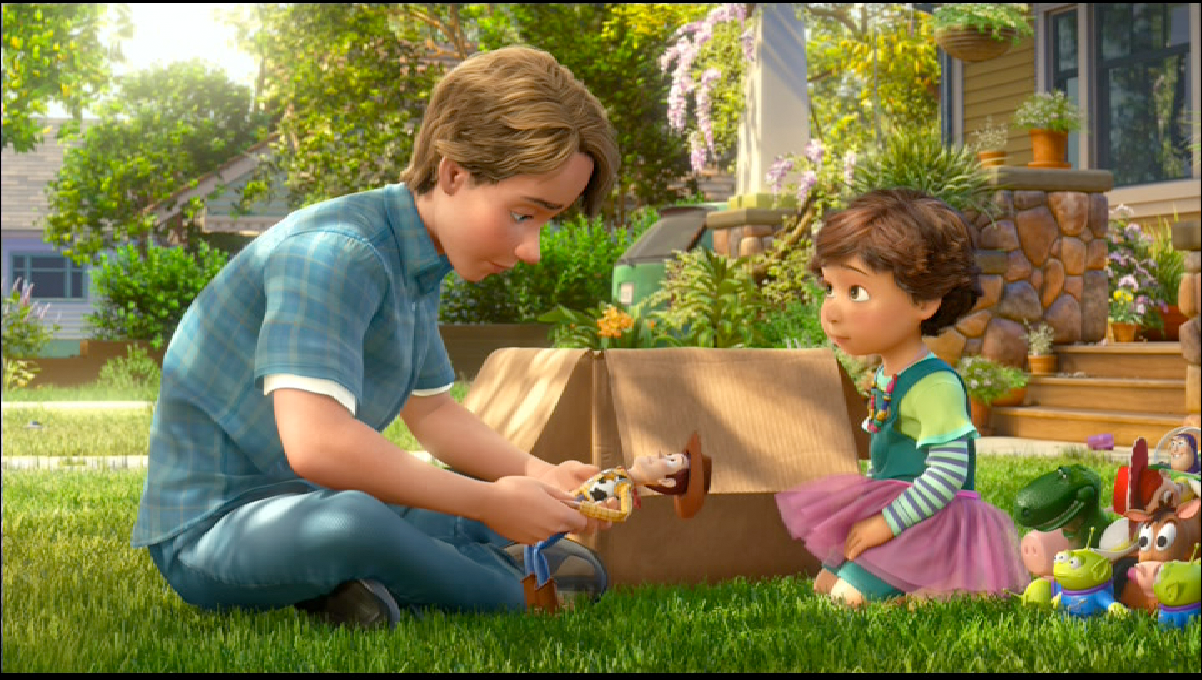
"Thanks, guys."
Of course, there are some interesting twists on the form of catharsis. Another one of my favorite movies, Up, plays with the form of tragic catharsis, particularly in the montage of Ellie and Carl. While this isn't a textbook tragedy form because of the fact the tragedy wasn't a 'fatal flaw' of Carl's, it still carries with it moments that are meant to arouse fear and pity from the viewer. One could argue that the montage quickly brings these moments to the 'brim' by incorporating many meaningful and important moments of the two's romance that began when the two were children. One could argue this isn't a full cycle of catharsis, for there is no moment of enlightenment or healing where Carl can move forward with his life or learn from the past: the viewer is confronted with a collection of moments but is left without this 'gold' finished by the purification process that was undergone from the montage. It is essentially the opposite: Carl is lonely, grumpy, and alone. Though one could say that this is a 'tragedy' and 'catharsis' in itself, there is not this healing moment because there is no enlightenment or progress: these events simply happened to Carl and he has not taken control of them and neither has the reader.
The purification process is emphasized throughout the movie as Carl, even years later, cannot move on with his life in any shape or fashion. The movie itself follows Carl as he chases the couples mutual dream, something he has rejected doing: the moment of catharsis isn't truly realized until Carl is able to 'begin' his new life (a life enabled to him by the process of surviving/thriving in Paradise Falls). By the end of the movie, Carl, and thus the viewer are able to embrace the memory of Ellie and the dream fulfilled as Carl begins to finally move forward after years of stagnation. Carl is enlightened through out of all of these trials--he realizes he can honor Ellie's memory and live out the life she would have wanted him to live out--that he can take control of his life.

"I would like to award you the highest honor I can bestow: the Ellie badge."
So whichever theory one agrees with about the purpose of catharsis and what Aristotle wrote in Poetics, it is evident that the purpose is to bring emotional balance to the viewers. It is meant to essentially enlighten the viewers, whether not the ending is happy or tragic (though in modern times the endings are generally 'happy' though the tension is meant to increase to the point where the stakes are extremely high). The process of refinement is almost like placing a metal in the furnace to rid it of impurities. This makes the writer the goldsmith trying to create 'gold', something beautiful that resonates with the reader to the point where they are lost in wonder. In closing, catharsis can be extremely powerful and is worth looking to, for writers can utilize it by from the offset building to this moment of catharsis where there is a meaningful 'healing' of emotions. The goal of catharsis is to enlighten the reader as the resolution unfolds while at the same time stirring them to experience a moment of healing for this will leave a lasting impact upon them. It can lead to the ultimate connection to the heart.

No comments:
Post a Comment